


Quail Hollow Scouting Report: Prepare for the Truist Championship on Your SKYTRAK
The Green Mile has ended more tournaments than any three-hole stretch in professional golf. It has also ended more friendships in simulator rooms than anyone cares to admit.
Holes 16, 17, and 18 at Quail Hollow Club in Charlotte—the closing gauntlet that’s hosted PGA Tour events since 2003 and a PGA Championship in 2017—average nearly a full stroke over par when the best players on the planet play them under tournament pressure. For the rest of us, that number is considerably less flattering. But here’s the thing: Quail Hollow is available right now in SkyTrak’s Trackman Course Play pack, which means you can walk every fairway, study every green, and collect data on every shot before the Truist Championship tees off May 6.
That’s not a minor detail. The Truist Championship is a PGA Tour Signature Event—$20 million purse, stacked field, the kind of week where Scheffler, Rahm, and McIlroy all show up looking serious. And when the broadcast starts showing shot tracers and data overlays at Quail Hollow, you’ll already know the course. You’ll know which holes bite and which ones give. You’ll know because you played them—on your sim, with your data, with your swing.
This is a scouting report for simulator golfers. Think of it less like a course preview and more like a heist movie—where the crew studies the building blueprints before they ever walk through the front door.
The Course in Three Acts
Tom Fazio rebuilt Quail Hollow in 1997 on top of George Cobb’s original 1961 layout, and Arnold Palmer touched four holes in the 1980s between them. The result is a par-71 that plays over 7,500 yards from the tips—a big, broad-shouldered course with narrow fairways, abundant water, and greens that accept a precise shot and reject everything else.
The course breaks cleanly into three acts, and understanding the structure will change how you attack it on Course Play.
Act I: The Opening Six (Holes 1–6) — Survive
The first six holes at Quail Hollow are the hardest stretch on the course and among the hardest opening stretches on the PGA Tour schedule. Four demanding par-4s and a par-3 that plays 230 yards. Even Scottie Scheffler—who doesn’t seem to notice when courses are supposed to be hard—has historically played the opening stretch close to even par here. This is where the field separates not by who makes birdies, but by who avoids bogeys.
On your simulator, the temptation is to fire at everything. Resist that. Pull up your dispersion data after playing these six holes and look at where your misses land. If you’re consistently missing into trouble—water left on 1, trees right on 4, short-sided on the par-3 5th—you’ve identified the exact tendencies that would bury you in a real round.
The goal for Act I on the sim: play these six holes five times and track your bogey-or-worse rate. Tour players average about +0.4 over par across this stretch. If you can keep yours under +1.0 per hole, you’re managing the course, not just surviving it.
Act II: The Middle Six (Holes 7–12) — Score
This is where Quail Hollow gives back what it took. The middle stretch includes two reachable par-5s and a handful of shorter par-4s where your approach game determines whether you’re making birdies or burning opportunities. Jason Day won the 2018 Wells Fargo in part by going a combined 8-under across the middle stretch over four rounds. PGA Tour players historically score between 1.0 and 1.5 strokes under par through this section.
On your sim, this is practice territory for carry precision. The par-5s—the 7th and 10th—reward specific layup distances that leave full wedge approaches. Use your session data to find your optimal layup number. If your 52-degree wedge carries 105 yards with 9,200 rpm of spin from a full swing, your job is to leave yourself that exact distance. Not 80 yards. Not 120. The number that produces your highest spin and tightest dispersion.
This is where owning a launch monitor actually changes your strategy instead of just confirming what you already knew. The data tells you where to leave the ball. The sim lets you practice executing that plan against a course that rewards it.
Act III: The Green Mile (Holes 16–18) — Commit
The nickname isn’t a coincidence. The final three holes at Quail Hollow are a march to the finish that demands precision, nerve, and—above all—commitment to a shot shape.
Hole 16 (par-4, 504 yards): A brute. The longest par-4 on the course, with water guarding the left side of the green. The approach is typically a long iron or hybrid into a green that slopes away from you. On the sim, check your long-iron carry distances. If your 5-iron carries 185 yards but the pin is at 195, you need to know that before you’re standing over the shot with a tournament on the line—or a $5 Nassau.
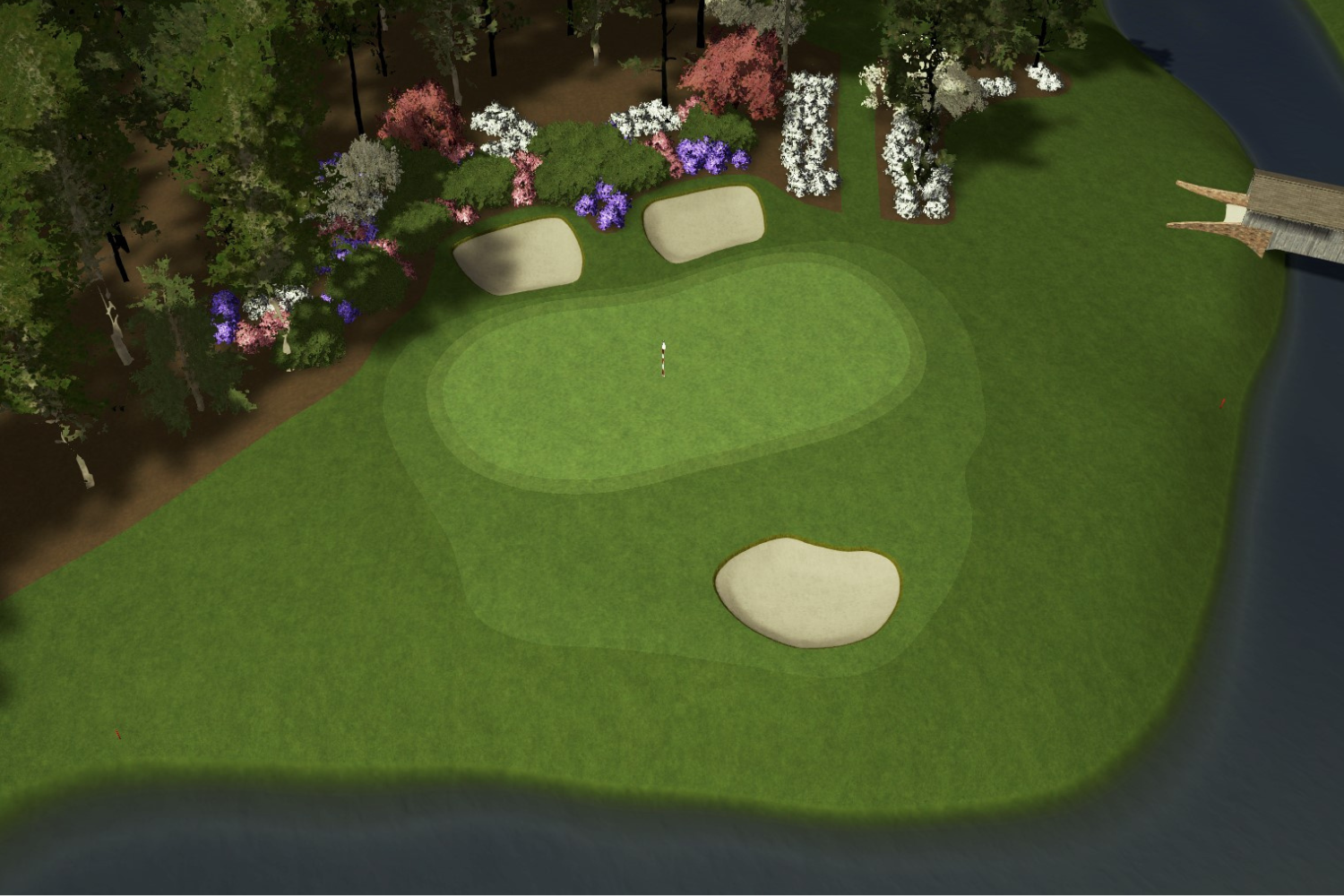
Hole 17 (par-3, 217 yards): The signature hole. A mid-iron over water to a peninsula green that’s given up some of the most spectacular collapses in PGA Tour history. Rory McIlroy dunked one here during the 2012 Wells Fargo and still won. Others haven’t been so lucky. The key data point on your sim: landing angle. A shot that comes in too flat on this green runs through the back into a grassy grave. You want a launch angle north of 30 degrees with enough spin to stop within 10 feet of where it lands.
Hole 18 (par-4, 493 yards): A sweeping dogleg left with water down the entire left side and a green tucked behind a creek. The tee shot demands a draw—or at least a committed straight ball that doesn’t leak right into the trees. Pull up your face-to-path data on the sim. If your natural shot shape is a fade, this hole requires a deliberate adjustment. Practice it here, with data, before you ever need it under pressure.
The Green Mile on Course Play isn’t just fun. It’s a diagnostic tool. Three holes, three different demands—distance, precision, and shot shape—and your launch monitor tracks all of it.
Your Sim Scouting Report: Data Targets by Section
Here’s a cheat sheet of the numbers to track during your Quail Hollow sim rounds. These aren’t tour benchmarks—they’re realistic targets for a 10-to-15-handicap simulator golfer who wants to play the course strategically instead of just muscling through it.
Opening Stretch (1–6):
Driver dispersion: under 40 yards total spread
Bogey-or-worse rate: track it, aim for under 50%
GIR on the par-3s: 1 out of 2 minimum
Middle Stretch (7–12):
Wedge carry precision: within 5 yards of target distance
Wedge spin rate: 8,000+ rpm from full swings
Birdie-or-better rate: aim for 2 out of 6 holes
Green Mile (16–18):
Long iron carry: know your exact 5-iron and 4-iron carry to the yard
Landing angle on 17: 30+ degrees
Face-to-path on 18 tee shot: practice until you can produce a draw (path 2–4 degrees right of face)
These numbers live in your sim software after every session. On a SkyTrak ST MAX, you get both club data (path, face, attack angle) and ball data (spin, launch, carry) in a single readout. Trackman’s Course Play pack—which is where Quail Hollow lives—feeds the same data into its virtual round interface. The Foresight GC3 and GCQuad deliver comparable accuracy through their camera systems if you’re running third-party course software.
The hardware doesn’t matter as much as the habit. Review your data after every sim round the way a film director reviews dailies—scanning for the moments that worked, the moments that didn’t, and the patterns connecting them. The raw footage is useless until someone sits down and watches it with a critical eye.
What to Watch During the Truist Championship Broadcast
When the tournament starts May 6, you’ll have a built-in advantage: you’ve already played the course. Here’s how to watch with informed eyes.
•Track the scoring distribution by section. The broadcast will show hole-by-hole scoring averages. Compare them to your sim rounds. Where the pros struggle, you probably struggled worse—but the shape of the difficulty curve should look similar. If the 17th is the hardest hole for the field and it was also your worst hole on Course Play, that’s not a coincidence. That’s course design doing its job regardless of skill level.
•Watch tee shot shapes on 13, 14, and 18. These are the holes where shot shaping matters most. Note which players hit draws, which hit fades, and what their face-to-path numbers look like when the broadcast shows them. Then compare to your own data from the sim.
•Pay attention to layup distances on the par-5s. Tour players don’t lay up to random spots. They lay up to specific yardages that match their best wedge distance. You should be doing the same thing on Course Play—and now you’ll see the principle in action at the highest level.
The Green Mile Challenge: A Practice Protocol
Here’s a standalone session you can run any time before—or during—tournament week:
Play holes 16, 17, and 18 five times each in Course Play. That’s 15 shots with consequences (virtually, at least). After each set of five, pull your data and look for patterns. Are you consistently coming up short on 16? Is your landing angle on 17 too shallow? Are you leaking right on 18 when you need a draw?
The goal isn’t to par the Green Mile five times. The goal is to shrink the variance. When Max Homa won the 2019 Wells Fargo, he played 16–18 in just one over par for the week—steady, not spectacular. A Tour pro’s dispersion on these holes is tight because they’ve hit these shots thousands of times. You won’t match that—but you can identify your biggest leak, fix it, and come back next session measurably tighter.
That’s the difference between hitting balls and practicing. One fills time. The other changes your game.
The Bottom Line
Quail Hollow is one of those courses that looks manageable on a scorecard and plays like a final exam. The opening stretch punishes. The middle stretch tempts. The Green Mile decides. And thanks to SkyTrak’s Trackman Course Play pack, you can take that exam as many times as you want before the Truist Championship puts the best players in the world through it on live television.
Play the course. Study your data. Watch the broadcast with numbers in your head instead of just pictures.
Then play it again—and see if your numbers moved.
────────────────────────────────────────────────────────────
Frequently Asked Questions
Can I play Quail Hollow Club on my golf simulator?
Yes. Quail Hollow is available through SkyTrak’s Trackman Course Play pack, which includes a library of real-world courses rendered from high-resolution mapping data. You’ll need a SkyTrak device paired with a Trackman Course Play subscription to access the course. Other simulator platforms may offer Quail Hollow through different software packages—check your specific software library for availability.
What is the Green Mile at Quail Hollow?
The Green Mile is the nickname for the final three holes at Quail Hollow Club—the 16th (504-yard par-4), 17th (217-yard par-3 over water), and 18th (493-yard par-4 with a dogleg left). Together they average nearly a full stroke over par on the PGA Tour and have produced some of the most dramatic finishes in tournament history. The name references both the difficulty and the long walk from the 16th tee to the 18th green.
What launch monitor data should I track when playing Quail Hollow on a simulator?
Focus on four metrics: driver dispersion (total spread in yards) for the tight opening holes, wedge carry precision (within 5 yards of target) for the scorable middle stretch, landing angle (30+ degrees) for the par-3 17th’s peninsula green, and face-to-path relationship for the tee shots on dogleg holes like 18. The SkyTrak ST MAX captures all of these—club data via dual Doppler radar and ball data via photometric camera.
How does SkyTrak Course Play compare to other simulator software?
SkyTrak’s Trackman Course Play pack offers photorealistic renderings of real courses built from precise topographic and aerial data. It’s one of several simulator software options—others include E6 Connect, TGC 2019, and WGT—each with different course libraries and features. Course Play’s strength is its course accuracy and integration with Trackman’s data engine. Your choice depends on which courses you want to play and which software features matter most to your practice style.
When is the 2026 Truist Championship at Quail Hollow?
The Truist Championship runs May 6–10, 2026 at Quail Hollow Club in Charlotte, North Carolina. It’s a PGA Tour Signature Event with a $20 million purse, meaning the field includes most of the top-ranked players in the world. The tournament was formerly known as the Wells Fargo Championship and has been held at Quail Hollow since 2003.


Leave a comment
All comments are moderated before being published.
This site is protected by hCaptcha and the hCaptcha Privacy Policy and Terms of Service apply.